
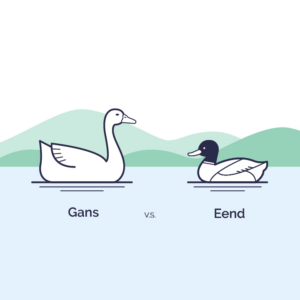
During your search for a duvet, pillow, or jacket, you want to know the difference between goose down and duck down. Down is the fluff found beneath the feathers of waterfowl; it ensures the bird stays warm.
However, there are differences in the down of various birds. Only the down and feathers of ducks and geese are used as filling material for pillows and duvets. The differences between duck and goose down are as follows:
| Goose Down | Duck Down | |
|---|---|---|
| Price | Scarce natural product and therefore relatively expensive | Less scarce than goose down and therefore cheaper |
| Insulation Value | Excellent | Very Good |
| Moisture Absorption | Excellent | Very Good |
| Scent | Neutral | Slightly stronger scent than goose down |
| Structure | Goose feathers are less sharp and less likely to prick through the ticking. | Duck feathers are somewhat sharper and prick through the ticking more easily. |
| Durability | Goose down often comes from older and larger birds, making the down more resilient and durable. | Duck down comes from smaller birds, making it slightly less resilient and durable (the difference is negligible compared to goose down). |
The difference between goose down and duck down therefore mainly lies in the insulation value, weight, price, and durability. We will explain the differences between the various types of down in more detail below, section by section.
1. The price difference between goose and duck down
Down is a byproduct of the meat industry. The amount of available down is therefore largely dependent on the demand for duck and goose meat. Outdoors.org indicates that in recent years, the demand for geese has decreased, resulting in a lower supply of goose down. Due to this limited availability, the price has gone up. There is relatively more demand for ducks, which keeps the price of duck down relatively lower.
2. The insulation value
Down has a high insulation value. This means you need relatively little down filling to keep you nice and warm. There is a reason why manufacturers often choose down filling for winter jackets, sleeping bags, and duvets.
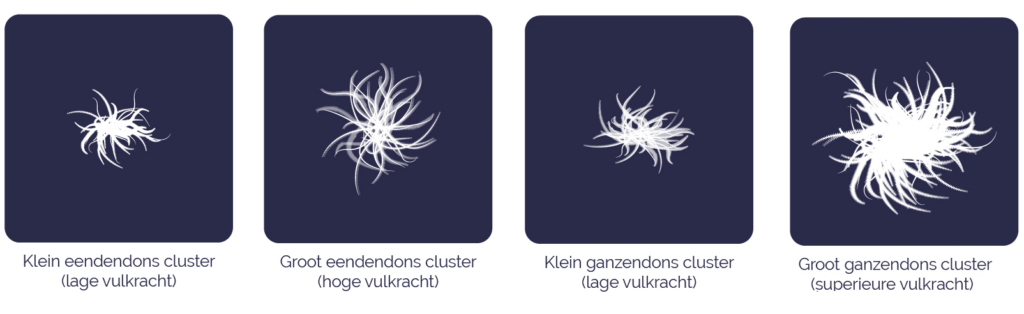
The size of a down cluster determines how insulating the down is. Since a goose is larger than a duck, it stands to reason that the goose also has larger down clusters than a duck.
This means that goose down usually has a higher insulation value than duck down. Therefore, less goose down is needed to achieve the same level of warmth in duvets. And less filling, in turn, results in a lighter duvet. Many people find a light duvet more comfortable than a heavy one because it takes less energy to move in bed.
3. Moisture absorption
Did you know that you lose an average of about 2 dl of moisture every night while sleeping? That is why it is so important to choose bedding that can effectively absorb the moisture from night sweats. Down naturally has high moisture absorption.
When comparing goose and duck down, goose down has a slightly higher moisture absorption due to the structure of the down.
4. Durability
A down duvet is a textile product. The textile sector uses the Higg Materials Sustainability Index (Higg MSI) to calculate the environmental impact of the most commonly used materials.
The Higg MSI index shows that the production of down has a lower impact on the environment than wool and polyester. The lower the score, the lower the material’s impact on the environment.
| Material | Higg MSI (lower is better) |
|---|---|
| Down | 19 |
| Polyester | 28 |
| Wool | 71 |
When translated into percentages, you can see that down is 32% more sustainable than polyester and as much as 72% better than wool. This means that compared to synthetic fibers and wool, down is the most environmentally friendly option.
Down is a scarce natural product, and therefore companies do everything they can to harvest down at the lowest possible cost.
Sustainability and lifespan go hand in hand. The longer a product lasts, the more sustainable it is. By regularly airing and shaking your duvet, a down duvet can last about 7 to 10 years.
Goose down often comes from older and larger birds, which makes the down more resilient and durable.
5. The scent of down
Down is a natural product. As a result, down has a specific ‘feather scent’. The scent of goose down is less strong than that of duck down. This is because ducks live lower to the ground, and their belly and breast (where the down comes from) have more contact with the soil.
Although the cleaning and treatment process removes the vast majority of this scent, people with a strong sense of smell may find the down scent unpleasant at first. They sometimes need to get used to it. Fortunately, there are several solutions to help resolve that down scent.
6. The structure of the material
A tuft of down has the shape of a fluffy ball. It has a very fine, soft structure, with a tiny quill in the middle to hold everything together. You don’t see or feel this quill.
This 3D structure of down ensures it traps heated air effectively. Because down is so light and open, it also releases heat quickly, so a duvet or pillow with down filling does not feel stuffy.
On top of the down are larger feathers, known as down feathers. A feather is coarser in structure and provides more firmness to a duvet or pillow. A feather has a small shaft that can prick through the ticking of the duvet or pillow. Goose feathers are less sharp than duck feathers and therefore less likely to prick through the ticking. This is because the goose feathers used are generally more mature. The duck feathers used are relatively young and therefore somewhat sharper. Furthermore, the shape of a goose feather is rounder than that of a duck feather.
Fill power as a measure of quality
Goose down has a better reputation than duck down, but products filled with goose down are not necessarily of higher quality than products filled with duck down.

For example, duck down with a fill power of 150 mm / 30 grams is better than goose down with a lower fill power. Therefore, keep an eye on the fill power of the down when comparing the quality between goose and duck down products.
Responsible down
Do you want to be sure the down was obtained in a responsible manner? Look for the Responsible Down Standard (RDS) label or another label with a down tracking system. This certification means that the filling does not come from live-plucked birds and is only a byproduct of the meat industry. Additionally, the down is traceable from farm to production. The entire chain treats the ducks in a responsible way.
Conclusion
The quality difference between goose down and duck down is quite small. Suppose you have the choice between an 80% goose down or a 90% duck down duvet/pillow; in that case, the 90% duck down is the best choice. The difference in percentage is greater than the difference in the type of down.
Do you value top comfort and are you willing to pay a bit more for it? Then choose a 90% or 100% goose down duvet. Goose down retains its resilience longer, making it more durable and ensuring it lasts longer.
Top 3 duck down products
Duck down duvets and pillows offer a very favorable price-quality ratio.
Top 3 goose down products
The products below have a high insulation value, low weight, and a very fine finish. The formula for top comfort!
Sources:
Others also read


